

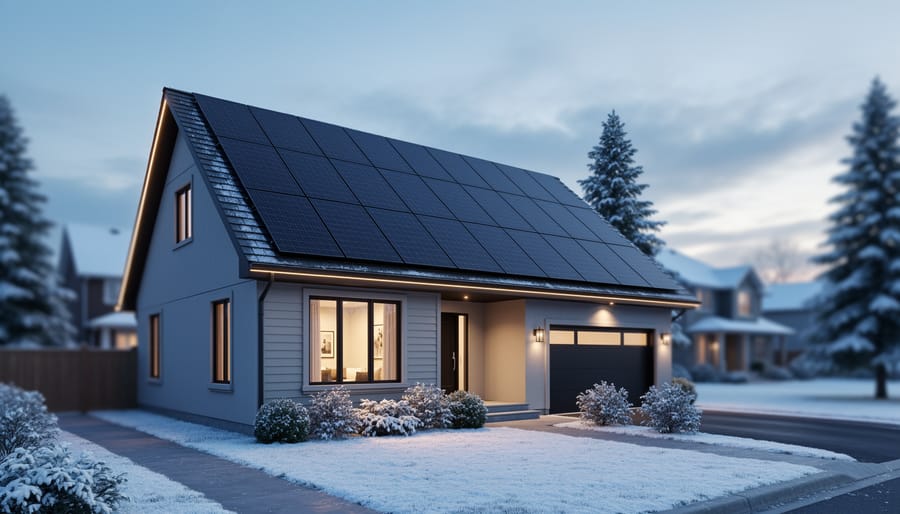
Ontario homeowners installed over 12,000 residential solar systems in 2025, and the momentum continues to build in 2026. If you’re considering joining them, you’re making this decision at a pivotal moment. The province’s net metering program now allows you to bank excess electricity credits year-round, while federal incentives through the Canada Greener Homes Grant can cover up to $5,000 of your installation costs. Combined with rapidly declining equipment prices, the typical 6-8 kilowatt residential system now costs between $15,000 and $22,000 before incentives, with payback periods shrinking to 10-15 years in most regions.
But the financial case is only part of the story. Ontario’s climate presents unique considerations that many people overlook during their research phase. Our cold winters actually boost solar panel efficiency, since photovoltaic cells perform better in cooler temperatures. Snow cover does reduce production temporarily, but modern panels shed snow quickly, and annual output remains strong. The province receives sufficient sunlight to make solar viable across all regions, from Windsor to Thunder Bay, though southern Ontario sees approximately 20% higher generation than northern communities.
Understanding how solar fits into Ontario’s electricity landscape matters too. Unlike jurisdictions with time-of-use export rates, net metering credits your excess generation at the same rate you pay for consumption. This means your system design should match your actual usage patterns rather than simply maximizing production. A well-sized system paired with energy-efficient upgrades delivers better returns than an oversized installation.
The path forward starts with assessing your roof’s solar potential, comparing quotes from certified installers, and calculating your personalized return on investment. This guide walks you through each decision point with Ontario-specific data, real household examples, and clear action steps.
The Current State of Solar Energy in Ontario
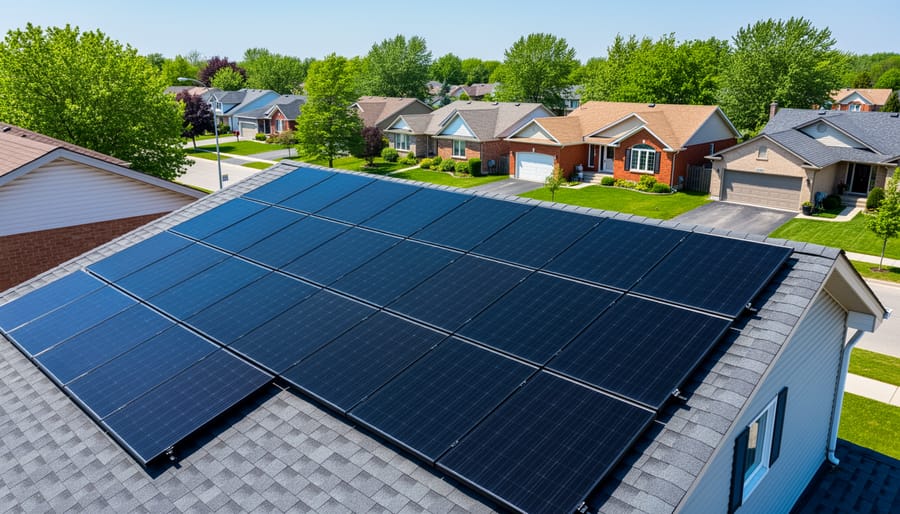
Ontario’s solar landscape has matured considerably, positioning the province as a growing player in Canada’s renewable energy transition. As of 2026, solar installations across Ontario represent a meaningful and expanding component of the provincial electricity system, with both utility-scale projects and residential rooftop systems contributing to capacity growth.
The province’s solar share of installed capacity has climbed steadily over recent years, reflecting improved economics and policy support. While hydroelectric power remains Ontario’s largest renewable source, solar has carved out an increasingly important role alongside wind and bioenergy in diversifying the generation mix. This diversification strengthens grid reliability and reduces reliance on natural gas during peak demand periods.
Recent milestones paint a picture of accelerating momentum:
- Over 5,000 megawatts of solar capacity now installed across the province, powering hundreds of thousands of homes.
- Residential installations have doubled since 2023, driven by falling equipment costs and rising electricity rates.
- Grid modernization investments totaling billions have enhanced the system’s ability to integrate distributed solar generation.
- Ontario’s Independent Electricity System Operator has streamlined connection processes, reducing wait times for homeowners and businesses.
- Several municipalities have adopted solar-ready building codes, making new construction more compatible with future installations.
Grid modernization efforts have proven essential to this expansion. Smart meters, advanced forecasting tools, and upgraded transmission infrastructure allow Ontario’s grid to handle variable solar output while maintaining stability. These technical improvements address earlier concerns about intermittency and make solar a practical, dependable energy source rather than a supplemental novelty.
Ontario’s broader renewable energy strategy now explicitly recognizes solar as a cornerstone of decarbonization goals. The provincial government has committed to phasing out remaining fossil fuel generation by 2030, creating space for solar and other clean sources to fill the gap. This strategic shift acknowledges that distributed solar generation reduces strain on aging infrastructure while empowering communities to participate directly in the energy transition.
What’s Driving the Solar Boom Across the Province
Financial Incentives and Support Programs
Ontario residents exploring solar have access to several financial programs that significantly improve project economics. The federal government’s Canada Greener Homes Grant offers up to $5,000 for solar installations that meet energy efficiency standards, while the province’s Residential Solar Program provides matching contributions for qualifying systems. Together, these can reduce upfront costs by $8,000 to $10,000 for typical residential installations.
Net metering remains one of the most valuable benefits for solar owners. When your panels produce more electricity than you use, your utility meter runs backward, earning you credits for exported excess power at retail rates. These credits roll forward indefinitely, meaning surplus summer production offsets winter consumption when panels generate less.
| Program | Eligibility | Benefit Amount | Application Process |
|---|---|---|---|
| Canada Greener Homes Grant | Homeowners with pre/post energy audits | Up to $5,000 | Apply through Natural Resources Canada portal |
| Ontario Residential Solar Program | Primary residences, income-qualified | $3,000-$5,000 matching | Submit with installer quote to provincial office |
| Net Metering | All grid-connected systems under 500kW | Retail rate credits on excess generation | Utility agreement after installation approval |
Financing options have expanded considerably. Major banks now offer green energy loans with preferential rates starting at 4.9%, and some utilities provide on-bill financing where monthly loan payments appear directly on electricity bills. For businesses, accelerated capital cost allowances allow immediate tax deductions on solar investments rather than multi-year depreciation schedules, improving cash flow substantially in the first year.
Technology Advancements Making Solar More Accessible
Solar technology has evolved dramatically to meet Ontario’s unique challenges. Modern panels now achieve 22-23% efficiency, a significant jump from the 15-17% standard just five years ago. This means homeowners can generate the same power from smaller rooftop footprints, ideal for urban Toronto homes or compact suburban lots where space is limited.
Battery storage represents perhaps the biggest breakthrough. Lithium iron phosphate systems now offer 10-15 year warranties and can store excess summer generation for winter use, addressing Ontario’s seasonal mismatch between peak production and peak demand. Costs have dropped nearly 60% since 2021, making backup power during grid outages genuinely affordable.
Smart inverters have transformed how systems interact with Ontario’s grid. These devices optimize energy flow in real-time, automatically adjusting to cloudy conditions or partial shading from nearby trees. They communicate with utility infrastructure, enabling seamless net metering and ensuring your system performs efficiently whether you’re in Thunder Bay experiencing -30°C or Windsor enjoying milder winters.
Bifacial panels, which capture reflected light from snow, now deliver 10-20% more energy during Ontario winters, turning our abundant snowfall from obstacle into advantage.
Understanding Solar Viability in Ontario’s Climate
One of the most persistent myths about solar energy in Ontario is that our harsh winters and variable weather make solar panels impractical. The reality? Ontario’s climate is surprisingly well-suited for solar power generation, and modern systems perform reliably year-round.
Solar panels actually function more efficiently in cold temperatures. While winter days are shorter, panels convert sunlight into electricity with greater efficiency when temperatures drop below 25°C. This means a crisp January day in Ontario can produce nearly as much power per hour of sunlight as a hot July afternoon. Germany, a world leader in solar adoption with less annual sunshine than Toronto, has proven that latitude and winter weather aren’t barriers to successful solar deployment.
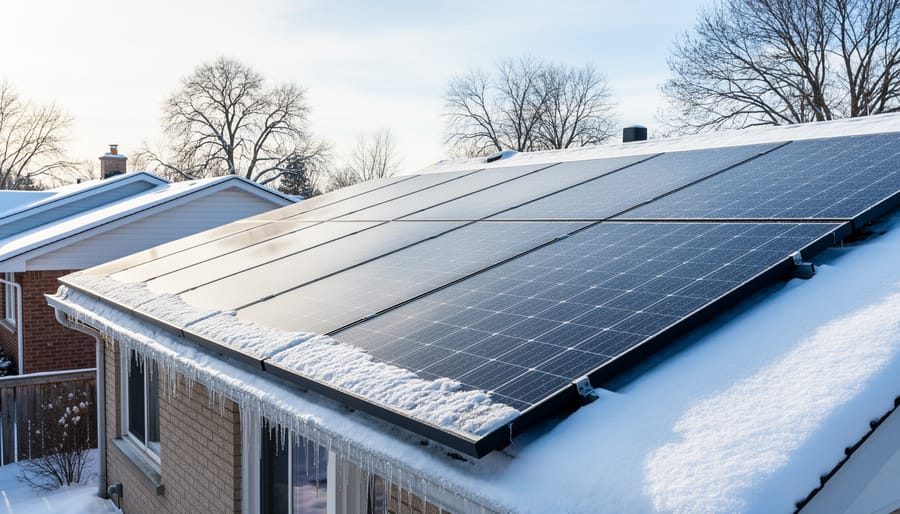
Snow accumulation rarely poses significant problems. Most panels are installed at angles that allow snow to slide off naturally, and their dark surfaces absorb heat that accelerates melting. Even a light dusting typically melts within hours once the sun emerges. For the occasional heavy snowfall, a roof rake or natural warming clears panels within days. Studies show that annual energy loss due to snow cover in Ontario averages just 2-4 percent.
Cloud cover reduces but doesn’t eliminate energy production. Panels still generate power on overcast days, capturing diffuse sunlight at roughly 10-25 percent of their peak capacity. What matters for system viability is annual sunshine hours, not perfect daily conditions. Southern Ontario receives between 1,800 and 2,100 hours of bright sunshine annually, comparable to regions with thriving solar industries.
Year-round performance data from existing Ontario installations consistently shows that properly designed systems meet 85-95 percent of projected annual output. The key is sizing your system based on realistic seasonal variation rather than summer-only generation, accounting for Ontario’s distinct climate patterns in the initial design phase.
Real Costs and Savings: What Ontario Homeowners Can Expect
In 2026, a typical residential solar installation in Ontario ranges from $15,000 to $30,000 before incentives, depending on system size and your home’s specific requirements. Most Ontario households install 6kW to 10kW systems, which provide enough energy to offset 60-90% of annual electricity consumption. These figures reflect current equipment costs, which have dropped roughly 40% since 2020 as panel efficiency has improved and supply chains have stabilized.
| System Size | Installation Cost (After Incentives) | Est. Annual Savings | Payback Period |
|---|---|---|---|
| 3kW | $9,000, $12,000 | $400, $600 | 15-20 years |
| 6kW | $16,000, $20,000 | $900, $1,300 | 12-16 years |
| 10kW | $24,000, $30,000 | $1,500, $2,200 | 11-15 years |
Your actual savings depend on electricity rates in your area, your current usage patterns, and how much excess power you sell back to the grid through Ontario’s net metering program. With electricity rates climbing an average of 3-4% annually, your savings accelerate over time while your solar payment remains fixed.
Installation costs include panels, inverters, racking systems, electrical work, permits, and inspections. Most reputable installers provide comprehensive warranties: 25 years on panel performance, 10-15 years on inverters, and workmanship guarantees of 5-10 years. Maintenance requirements are minimal, panels need occasional cleaning and an inverter replacement around year 12-15, typically costing $2,000-$3,000.
Beyond monthly bill reductions, solar panels increase property value. Recent Ontario real estate data shows homes with solar systems sell for 3-5% more than comparable properties, and they spend fewer days on the market. Buyers recognize the appeal of predictable energy costs and reduced environmental impact.
The 11-20 year payback period means panels pay for themselves well before their 25-30 year lifespan ends, delivering a decade or more of essentially free electricity. When you factor in avoided utility rate increases, environmental benefits, and property value gains, the financial case becomes compelling for most Ontario homeowners with suitable roofs and moderate-to-high electricity usage.
Community Solar Projects Leading the Way
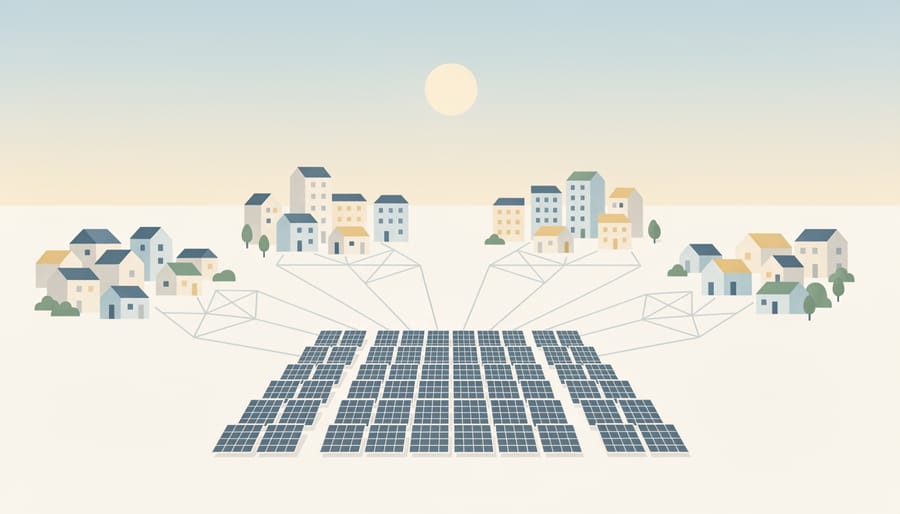
Ontario’s community solar movement is reshaping how residents access renewable energy, especially for those unable to install panels on their own properties. Renters, condo owners, and homeowners with shaded roofs now have viable pathways to solar participation through shared installations.
The Toronto Community Housing Corporation launched one of the province’s largest social housing solar projects in 2025, installing panels across 30 buildings. Residents in these units receive credits on their electricity bills proportional to their building’s solar generation, cutting average monthly costs by 15-20%. This model demonstrates how multi-unit dwellings can overcome the barriers that previously excluded apartment residents from solar benefits.
In rural Eastern Ontario, the Rideau Environmental Action League coordinated a cooperative solar farm near Smiths Falls. Thirty-seven households purchased shares in a 100-kilowatt ground-mounted array built on underutilized farmland. Members receive net metering credits based on their ownership stake, with excess generation feeding back into the local grid. The cooperative structure spread installation costs across participants while delivering economies of scale that individual rooftop systems couldn’t match.
Indigenous-led initiatives are also advancing energy sovereignty. The Fort William First Nation completed a 500-kilowatt solar installation in 2024 that powers community buildings while providing hands-on training in renewable energy careers for band members. Similar projects are underway in Curve Lake and Six Nations, combining clean energy goals with economic development and skills building.
These collaborative approaches prove that solar adoption needn’t depend on homeownership or perfect south-facing roofs. Community solar creates accessible entry points for diverse Ontarians to participate in the energy transition while strengthening local resilience and shared environmental stewardship.
Environmental and Health Benefits Beyond Carbon Reduction
When you choose solar panels for your Ontario home, you’re doing more than cutting carbon emissions, you’re directly improving the air your family breathes and strengthening community health across the province.
Ontario still relies on natural gas plants during peak demand periods, particularly in summer and winter. These facilities release nitrogen oxides, sulfur dioxide, and particulate matter that drift into nearby neighborhoods. Every kilowatt-hour your solar system generates means one less kilowatt-hour from these plants, reducing the pollutants linked to asthma attacks, bronchitis, and cardiovascular problems. Children and older adults face the highest risks from poor air quality, making residential solar adoption a tangible health intervention for vulnerable populations.
The benefits multiply as more homes go solar. A 2025 Ontario public health study found that neighborhoods with higher concentrations of rooftop solar experienced measurably better air quality during summer months compared to areas dependent entirely on grid power. Fewer emergency room visits for respiratory distress followed, particularly on high-demand days when fossil fuel plants would normally ramp up production.
Solar energy also supports Ontario’s commitment to achieving net-zero emissions by 2050. The province has set interim targets of reducing greenhouse gas emissions by 30% below 2005 levels by 2030. Residential solar systems contribute directly to this goal while demonstrating that climate action and public health aren’t separate priorities, they’re deeply intertwined.
Beyond measurable health outcomes, widespread solar adoption reduces thermal pollution in waterways from power plants and decreases habitat disruption from fuel extraction and transport. These ecological improvements create healthier ecosystems that support cleaner drinking water and more resilient food systems.
Your decision to install solar panels extends far beyond your property line. It becomes part of a collective shift toward energy systems that protect both planetary and human health, proving that individual choices can drive systemic change.
Taking Your First Steps Toward Solar
Start by evaluating whether your property is a good candidate for solar. South-facing roofs with minimal shade between 9 a.m. and 3 p.m. typically perform best, but east-west configurations can still deliver solid results. Check your roof’s condition, if it needs replacement within five years, handle that first to avoid costly panel removal and reinstallation later. Most Ontario homes with asphalt shingle or metal roofs work well, while older slate or wood shake may require additional structural assessment.
Review your electricity bills from the past year to understand your consumption patterns. Higher usage means greater potential savings, but even modest consumers can benefit from solar given Ontario’s rising electricity rates. Note your current rate tier and time-of-use periods, as these affect your payback calculations.
Once you’ve confirmed basic suitability, follow these steps to move forward:
- Request quotes from at least three licensed solar installers with Ontario-specific experience and verified references
- Compare proposals carefully, examining equipment warranties, production guarantees, and what’s included beyond the panels themselves
- Schedule a detailed site assessment where the installer evaluates structural capacity, electrical panel upgrades needed, and optimal panel placement
- Apply for provincial and federal incentives before finalizing your contract to understand your actual out-of-pocket costs
- Work with your installer to obtain required building permits and electrical safety authority approvals, reputable companies handle this process
- Coordinate utility company approval for net metering connection, which allows you to receive credits for excess power sent to the grid
- Schedule installation during Ontario’s drier months when possible, though modern teams work year-round
- Complete final inspection and grid connection, then monitor your system’s performance through the provided app or portal
Read contracts thoroughly before signing. Ensure they specify panel brands, inverter models, expected annual production in kilowatt-hours, warranty terms, and maintenance responsibilities. Reputable installers provide post-installation support and performance monitoring to catch issues early.
Ask potential installers about their experience with Ontario’s specific permit requirements and whether they’re certified by the Canadian Solar Industries Association. A quality installer will answer questions patiently, provide local references, and never pressure you into rushed decisions.
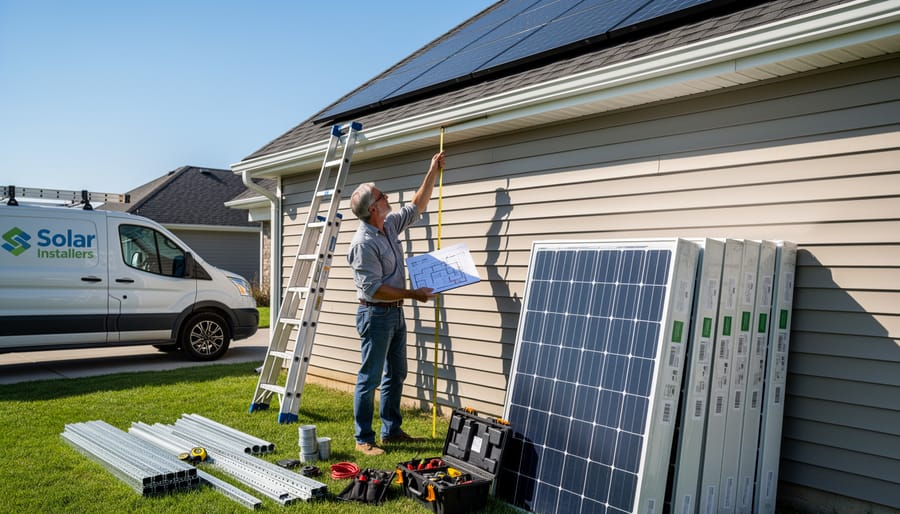
The momentum behind solar panel adoption in Ontario represents far more than a shift in how we power our homes. Each installation contributes to a collective transformation that strengthens community resilience, improves air quality, and reduces the health burdens associated with fossil fuel combustion. When your neighbor installs solar panels, they’re not just lowering their electricity bill, they’re helping stabilize the grid, reducing demand during peak hours, and demonstrating that clean energy transitions are practical and achievable.
The financial case for solar in Ontario has never been stronger. With system costs at historic lows, robust incentive programs, and rising electricity rates, the numbers work for a growing number of households. But the true value extends beyond personal savings. Every kilowatt-hour generated from your rooftop is a kilowatt-hour that doesn’t come from natural gas or coal, translating to cleaner air for everyone who breathes it and a more stable climate for future generations.
Starting your solar journey doesn’t require perfect conditions or an unlimited budget. It requires taking that first step: requesting quotes from local installers, attending a community solar meeting, or simply calculating your home’s potential. Ontario’s sustainable energy future is being built one rooftop at a time, and there’s a place for you in that movement. The question isn’t whether solar makes sense for Ontario, it’s how you’ll participate in the transition that’s already underway.